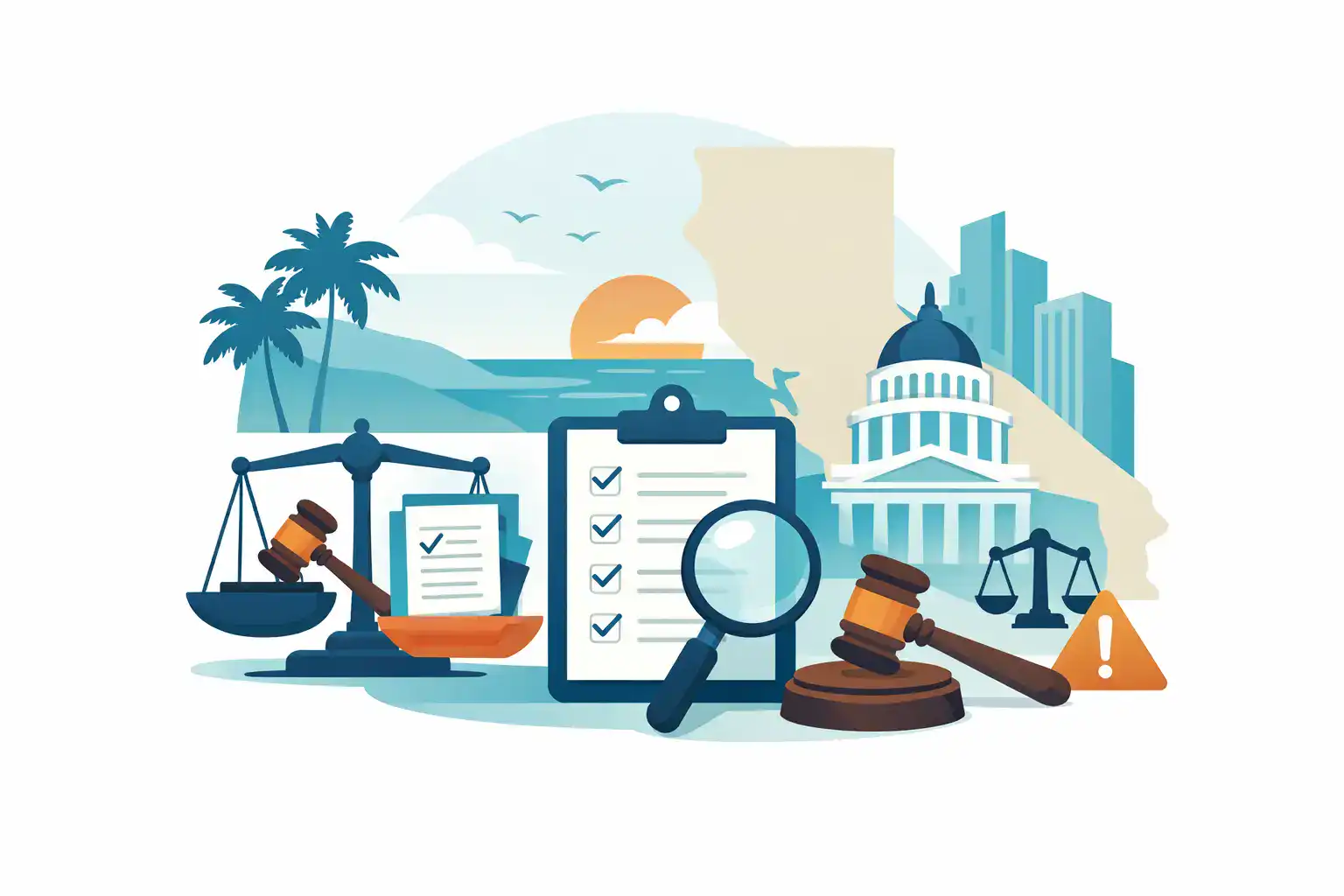
California rarely changes one compliance obligation at a time. More often, organizations face layered updates across notices, recordkeeping, employment practices, privacy expectations, housing rules, and sector-specific oversight. That is what makes California compliance law changes operationally significant – not just legally significant. For regulated businesses and administrative teams, the real challenge is turning moving legal requirements into controlled, documented workflows that can withstand review.
For most organizations, the first mistake is treating legal change as a policy issue only. In practice, a new state requirement often affects intake forms, signature processes, retention schedules, vendor oversight, mailing procedures, training logs, and how proof of compliance is stored. If those connected systems are not updated together, the organization may still carry exposure even after revising a written policy.
Why California compliance law changes create operational risk
California remains one of the most active state jurisdictions for regulatory change. That matters even for organizations with a national footprint because California standards often apply based on employee location, resident status, property location, transaction volume, or business activity touching the state. A company headquartered elsewhere may still be pulled into California obligations through remote staff, consumer relationships, lending activity, tenant interactions, or digital record practices.
The practical burden is rarely limited to understanding the law itself. Compliance teams must determine which entities are covered, when obligations take effect, whether any phased implementation applies, and what documentation will prove adherence. Small wording changes in notice language or timing rules can have outsized consequences during an audit, claim, investigation, or dispute.
This is why change management matters as much as legal interpretation. A requirement is only as defensible as the record trail behind it.
Where California compliance law changes hit hardest
Some categories create more recurring disruption than others. Employment and HR remains a high-volume area because California frequently updates leave rules, wage and hour requirements, anti-discrimination obligations, workplace postings, retaliation protections, and record retention expectations. These changes affect not only handbooks and postings but also onboarding packets, payroll coordination, manager training, and complaint documentation.
Housing and property management is another pressure point. State and local overlays can alter notice delivery requirements, tenant communications, fee restrictions, screening practices, habitability obligations, and eviction-related procedure. In this environment, a compliant action is often inseparable from a compliant paper trail. The timing of a notice, method of delivery, and retained proof of service may matter as much as the substance.
Financial services and verification-dependent institutions also face a difficult California landscape. Consumer privacy expectations, disclosure obligations, complaint handling, identity verification controls, adverse action documentation, and retention practices can all shift. For these organizations, the issue is not just whether an action occurred, but whether the institution can demonstrate that the action occurred in the correct sequence and under the correct standard.
Electronic notice and digital records deserve separate attention. California organizations increasingly rely on digital delivery, electronic signatures, and platform-based acknowledgments. That can improve efficiency, but only if the process satisfies legal consent, accessibility, authenticity, and retention requirements. A digital workflow that is convenient but poorly documented may create more risk than a slower manual process.
A practical response to California compliance law changes
The most effective approach is disciplined and system-oriented. Start with applicability, not assumptions. Many compliance failures begin because a business adopts a simplified view of a law change without confirming whether the rule applies by industry, entity size, transaction type, or location. A cross-functional review should identify where the organization is actually exposed.
Once applicability is clear, map the affected workflow from beginning to end. If a rule changes notice language, ask where that notice is generated, who approves it, how it is delivered, how delivery is verified, and where the proof is retained. If the law changes a timing requirement, determine whether the timing is controlled manually, through software, or by a third-party vendor. If no one owns the timing control, the organization does not yet have a reliable compliance process.
Then move to records. In regulated environments, undocumented compliance is weak compliance. Organizations should identify what evidence would be needed six months or two years later if a regulator, counterparty, tenant, employee, examiner, or court asked for proof. That usually includes dated notices, version-controlled forms, acknowledgment logs, mailing certificates, signature records, policy approvals, training completion records, and exception handling notes.
This is also where registry-based control adds value. Centralized validation, formal document handling, and standardized record discipline reduce the common problem of compliance evidence being scattered across inboxes, local drives, portals, and vendor systems. National Compliance Registry operates in this area because many institutions do not need more commentary about compliance – they need better administrative proof.
The trade-offs organizations need to evaluate
Not every response to legal change should be immediate, broad, and expensive. Some California compliance law changes require full process redesign. Others call for narrower updates to forms, scripts, notices, or retention settings. The correct response depends on risk level, enforcement posture, operational scale, and the sensitivity of the activity involved.
There is also a trade-off between speed and control. Moving quickly to update policies can create the appearance of responsiveness, but if downstream forms and records are not aligned, the organization may create inconsistency. On the other hand, waiting too long for perfect clarity can leave outdated procedures in place after an effective date. Strong compliance teams manage this by using interim controls, documented implementation dates, and formal version tracking.
Another variable is decentralization. Large organizations often allow regional teams or business units to manage their own notices and records. That can support flexibility, but California-specific obligations often expose the weakness of fragmented administration. If one business unit updates a disclosure and another continues using the old version, the organization inherits uneven risk. Standardization is not always the fastest route, but it is usually the more defensible one.
What regulated organizations should review now
A useful review starts with notice frameworks and record integrity. Confirm whether legal notices, employee communications, tenant forms, consumer disclosures, and adverse action templates reflect current California requirements. Then confirm whether delivery methods still satisfy applicable standards, especially where certified mail, electronic notice, or digital acknowledgment processes are involved.
Next, review retention and retrieval. Many organizations technically keep records but cannot retrieve them efficiently by person, property, transaction, or date range. That becomes a serious weakness during inquiries or disputes. Compliance records should be searchable, complete, and tied to the specific obligation they support.
Vendor reliance also deserves scrutiny. If payroll platforms, property management systems, e-signature tools, mailing vendors, or verification providers handle part of the compliance workflow, the organization should not assume legal sufficiency. Third-party functionality can help, but responsibility usually remains with the organization. Vendor output should be tested against actual legal and procedural requirements, not accepted at face value.
Training is the final control point that often gets overlooked. A revised policy does little if managers, property staff, credentialing teams, or operations personnel continue using outdated scripts or legacy forms. Training should be targeted to the role, tied to the workflow, and supported by retained evidence of completion.
Building a defensible change-management process
The organizations that handle California well usually follow a repeatable pattern. They monitor legal developments continuously, classify changes by risk and applicability, assign ownership, update controlled documents, test workflow changes, train affected personnel, and retain implementation evidence. That process is less glamorous than broad legal analysis, but it is what creates defensibility.
It also helps to distinguish between legal awareness and compliance completion. Awareness means the organization knows a law changed. Completion means the organization can prove that notices, systems, records, and responsible personnel were updated in a traceable way. Regulators and counterparties tend to care far more about the second category.
For institutions with multistate operations, California can serve as a stress test for governance maturity. If the organization can absorb California compliance law changes through a structured process with clean documentation and accountable ownership, it is more likely to manage other jurisdictions effectively as well. If every update turns into a scramble across departments, the issue is probably not California alone. It is the absence of a durable compliance administration framework.
The most reliable posture is not constant reaction. It is controlled readiness. When legal requirements shift, organizations with disciplined records, validated workflows, and formal notice procedures are in a far stronger position to respond without losing administrative control. That is the standard worth building toward.